
How I Design Weddings: “Less Is More” Politely Doesn’t Apply Here
There’s a design phrase that gets thrown around so often in the wedding industry that it’s basically become background noise: less is more.
I’ve never agreed with it.
Not because I think weddings should be chaotic or “busy for the sake of busy,” but because I believe in intentional abundance. There’s a very real difference between something that’s visually overwhelming because it’s poorly executed, and something that’s immersive because every single layer has been designed with purpose.
I don’t design weddings to be minimal.
I design them to be experienced.
And yes – there is a difference.
My Wedding Design Philosophy: More Is More (and No, I’m Not Apologizing for It)
My approach to luxury wedding design is rooted in one core belief: a space should never give your eye only one thing to do. That sounds simple, but it completely changes how a room gets built.
I want movement. I want visual rhythm. I want layered focal points that continuously redirect attention so the guest is always discovering something new instead of politely staring at one centerpiece like it owes them money.
When someone walks into a wedding I design, I don’t want their first reaction to be “that’s pretty.”
I want silence.
The kind where people forget what they were about to say.
Not because they’re confused – but because their brain is doing a full system update.
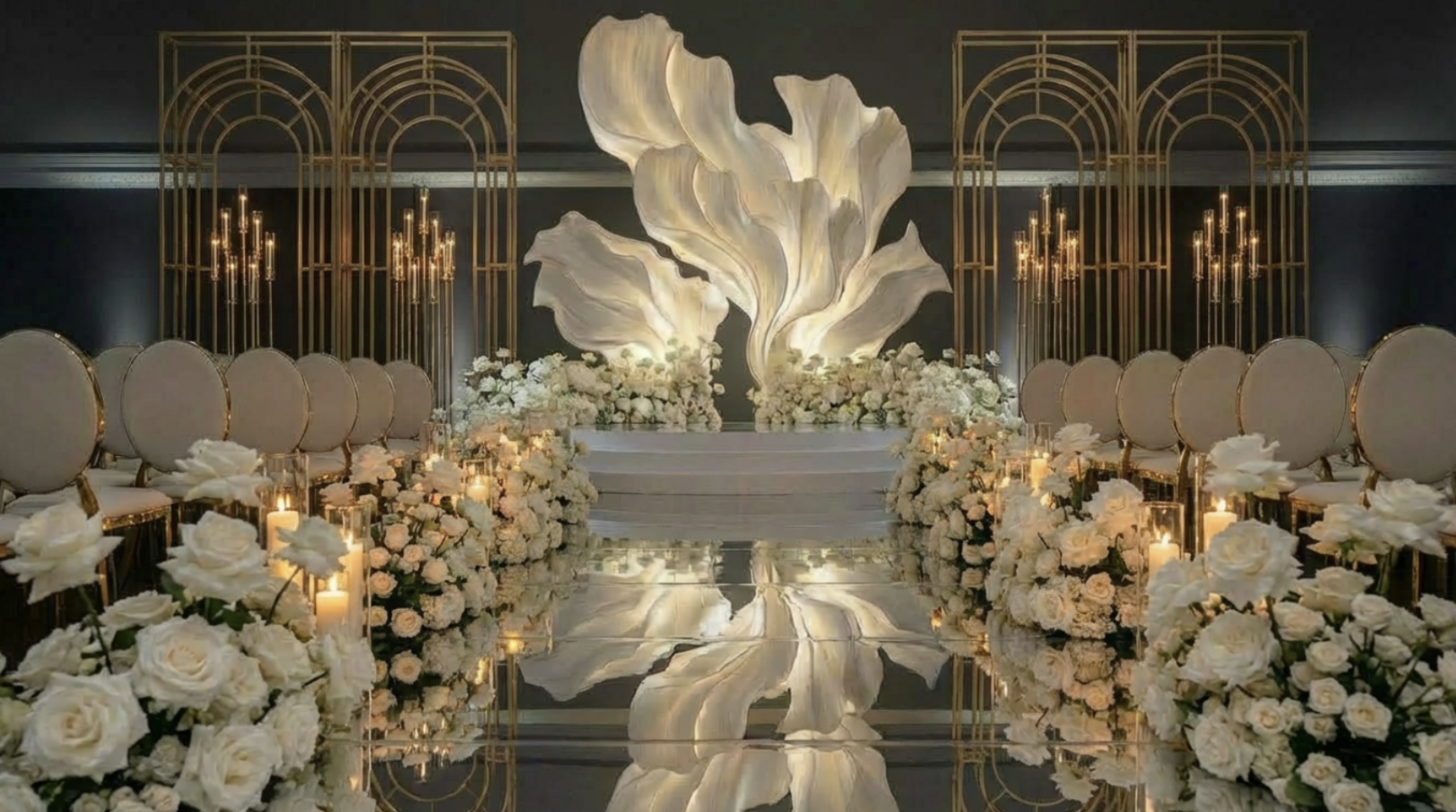
Tall floral installations, sculptural ceremony pieces, dense floral layering, mirrored aisles, textured tablescapes, dramatic lighting – none of this is “extra” in my world. It’s architectural decision-making.
A wedding shouldn’t feel like a backdrop.
It should feel like a full environment that surrounds you… slightly humbles you… and then politely refuses to be ignored.
Architectural Romance: Where I’m Currently Causing Beautiful Problems
Right now, I’m working on a styled shoot concept called Architectural Romance, and it is basically my entire design philosophy in physical form.
Every space has its own focal point. Ceremony, reception, sweetheart table, lounge – none of them are just “areas.” They are moments.
Because I don’t believe in giving guests a room where nothing is happening and calling it “elegant.”
We are not doing empty space and calling it intentional. I’m sorry.
For the ceremony, I’m creating sculptural wave-like structures that feel more like architectural art than traditional décor, paired with oversized floral movement that softens the structure at the base.
The aisle is mirrored – yes, mirrored – so everything happening around it reflects back into itself. Florals, lighting, movement… all multiplied. Because apparently reality wasn’t already interesting enough.
At the end of the ceremony space, I’m placing a mirror that reflects the entire installation back onto the guests so they don’t just observe the moment – they’re visually inside it.
The goal is simple: I want goosebumps before people even realize they’re supposed to be emotional.
And if that sounds dramatic… it is.
That’s the point.
I design for all five senses:
- sight: scale, reflection, and movement
- smell: fresh florals that don’t smell like “event room with a hint of regret”
- touch: marble, velvet, layered textures
- sound: atmosphere, energy, and intentional pacing
- taste: food that actually deserves to be there
If one sense is ignored, the design is incomplete. And yes, I will die on that hill.
My Non-Negotiable: The Client Leads, Always
For all the drama in my design style, my starting point is actually very simple: what is the client most excited about?
That answer runs everything.
If the couple is obsessed with food – Michelin-star level, culinary experience is the love language type of people – then food becomes the hero. Not florals. Not installations. The food.
And I will absolutely design around that instead of trying to compete with it like an insecure centerpiece.
If the client prioritizes guest experience, then we build immersion. Interactive elements, unexpected moments, environments that make guests participate instead of just sit there and pretend they understand wine pairings.
Think Gatsby energy. Think theatrical. Think “why is there a man dressed like Leonardo DiCaprio handing me a drink and calling me sport?” Yes, that level.
But I am also very selective.
I don’t take every client.
If someone wants something very traditional or wants to recreate a wedding they’ve already seen, I’m probably not their designer and that’s okay. I’m at my best with clients who want to create something personal, unexpected, and distinctly their own.
How I Actually Build a Wedding: Controlled Chaos With a Timeline
My process starts long before anything looks pretty.
First, I think. A lot. Probably too much. I take a few days where I just absorb everything – hotels, architecture, furniture stores, films, lighting, textures. Anything can become a design reference if you’re actually paying attention.
Then I journal. A lot. Random notes, spatial ideas, emotional direction, fragments of concepts.
Once the vision starts forming, I move into:
- mood boards
- sketches
- AI renderings to visualize the concept in real space
That’s when things stop being “ideas” and start becoming “this is actually happening.”
Then I bring in vendors – especially florists and rental companies – and I show them the renderings. And yes, sometimes we all look at it and collectively agree “okay… how are we actually doing this?” and then we figure it out like adults.
We refine. We adjust. We problem-solve.
Then I take the venue floor plan and start building spatial logic.
Guest flow is everything. I don’t design pretty chaos where everyone is trapped behind a bar like it’s rush hour at a bad airport lounge. I think about movement – how people enter, where they pause, where energy builds, and where it needs to release.
Opulence without flow is just expensive confusion.
Before installation, every vendor gets a detailed event order with timing, placement, and responsibilities. Nothing is guesswork. On event day, I already know the sequence: structure first, then layers, then lighting, then detail work.
Because weddings are not just designed.
They are built.
The Biggest Misconception: “Isn’t That Too Much?”
Let’s talk about it.
The biggest misconception about my work is that it’s “too much” or that it becomes visually overwhelming.
But here’s the truth most people miss: maximal design done correctly is actually controlled restraint at a higher level.
If scale is the focal point, I simplify color. If color is the focal point, I reduce density. If texture is the story, everything else steps back.
Nothing competes with everything.
That’s the discipline.
Another misconception is cost. People assume “more is more” automatically means “more expensive.”
Sometimes yes. Sometimes no.
Because design is not just buying more things – it’s strategic placement, repetition, anchoring focal points, and using rental inventory in ways people don’t usually think about. A strong concept will always outperform a random expensive collection of items.
And guest experience? That’s where people are usually the most wrong.
Some assume tall centerpieces block conversation. But let’s be honest – guests are not sitting in silence at a dinner table like it’s a corporate compliance meeting. They’re in a full sensory environment with sound, lighting, movement, and energy.
A strong centerpiece doesn’t block connection.
It creates it differently. It shapes proximity. It creates intimacy within structure.
People don’t talk less because of design.
They talk differently because of it.
Final Thought: I Don’t Design for Safe, I Design for Remembered
I don’t design weddings to be minimal, safe, or politely forgettable.
I design them to be felt.
To be remembered.
To be the kind of experience people try to describe later and end up saying, “you just had to be there.”
Because in my world, less is not more.
It’s just less.
And I didn’t get into luxury wedding design to do “less.”
Looking for a Las Vegas wedding designer who thinks beyond centerpieces and Pinterest boards? Explore my wedding design services to see how I create immersive celebrations built around your story, your priorities, and the experience you want your guests to remember.
Ready to create something people haven’t seen before? Inquire here.
Then below that:
Planning your wedding? Read my guide on what to look for when hiring a wedding planner.
March 30, 2026
Leave a Reply Cancel reply
© 2026 ALN Event Design LLC. All Rights Reserved.
Based in las Vegas | travel worldwide
[email protected]

Privacy Policy
Terms of Use
714.743.3556
Be the first to comment